Alex’s life story interview
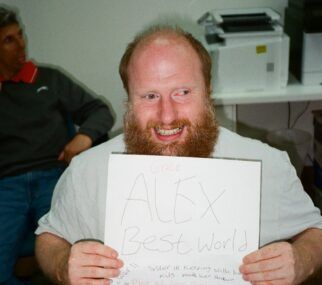
Alex
Date: June 2025
Location: Kingston-upon-Thames
Interviewed by: Donna
The full recording will be stored in the records of the The British Library when the Our Life Stories project closes. Short excerpts from the interviews are shared below, which give an insight in Alex’s full and detailed accounts.
The importance of hearing life stories
Alex talks about the Our Life Stories project; how he heard about it and why it’s important for people with disabilities and autistic people to have their stories heard.
Transcript
INTERVIEWER: How did you hear about this project?
ALEX: Through United Response.
INTERVIEWER: And do you find it interesting?
ALEX: Yes, it’s very good. It’s the history of people with learning difficulties and major disabled people can hang out in the community and feel that there’s somewhere for people and stuff.
INTERVIEWER: Do you think this project might work?
ALEX: For people to-
INTERVIEWER: With learning disabilities?
ALEX: Yeah, yeah. Like to fully engage – for like disabled people and learning difficulties just need help or to interact with people like themselves or all sorts of opportunities they can be open to.
INTERVIEWER: OK. Thank you.
ALEX: Yeah.
INTERVIEWER: What are you looking forward to about today?
ALEX: I just like – anyone would like to talk about themselves about their history. I think it’s – you get to see how things have changed over the years, and – was it better or worse? But one thing I know is everyone still fights for their dreams and still hope for better days. Maybe at the end we’ll know, but it’s good to let everybody know something about you because the world wouldn’t be interesting, I don’t think.
INTERVIEWER: No. Have there been opportunities for people with learning disabilities. To bring more awareness, do you think?
ALEX: I think – When I was growing up, I think learning difficulties there was a different perception of outlook of people with learning difficulties. I think it’s maybe because of technology and I think the persona of it is maybe a bit better, but there’s still a lot of work to be done. When I was – Yeah. Yeah. I think. Yeah. I think that’s it.
Life at school
Alex talks about his experience in educational settings. He explores his love of sport and fascination with history, explaining some of the periods of history he has the most interest in.
Transcript
INTERVIEWER: What was your favourite subject?
ALEX: I’d say History and Football. I played a lot of sports and one of the other ones was athletics. We did athletics every summer, and we used to do everything, like sand-jumping, high jump, 200meters, 1500meters and 60meters sprint and all sorts of that.
INTERVIEWER: Was there any teams, like football teams?
ALEX: No, no. In the athletics, we all had – there was a group of lines. So, it was the whole school. So, the juniors, the seniors. So the juniors were running against all the juniors in from each other team. And the seniors were doing the same thing. And then you could get big cup and I was in one of them teams. I’ve won it a few times, lost in it a few times. So yeah, it just randomly changes, but the team name stayed the same. So, it was quite fun. And the football team, yeah, I was in the school football team, in the juniors. We had a good football team all the way till I left, and I could tell you; I don’t know what it is, like you hear the Premiership. I played every minute of the game. I was never substitute, I played in two positions, I played in goal. Or, I would say like a forward winger. That was my role.
INTERVIEWER: If you had a chance, would you be a footballer?
ALEX: Yeah, I like football. Yeah.
INTERVIEWER: You’re going to make a career out of it, though?
ALEX: I wouldn’t say career. I mean, I liked playing. I mean, I proved over the years, I even going back as a toddler, I was useless. But, yeah, I got to a good playable level. I mean, I would never say I’d be professional, and I don’t – Yeah. I would say that at the moment there’d been more hurdles for disability football players. If they could do it, get into the professional game. I think there’d be too – I think we – I think for that to happen one day, I think a lot of hierarchies and a lot of funding and a lot of support for that to happen but-
INTERVIEWER: Yeah, like Paralympics but set in football.
ALEX: Yeah. Yeah. You would have to create a movement for that to happen, I think.
INTERVIEWER: Oh, yeah, you do. Oh, yeah.
ALEX: Yeah.
INTERVIEWER: Nothing that easy, is it?
ALEX: Life is as easy as you make it. It’s whether you want to fight or start anything [like a] project to see it through, I think.
INTERVIEWER: I think so.
ALEX: Yeah.
INTERVIEWER: So, I think – What do you like about the subject? I didn’t elaborate on the History bit. What do you like about the History?
ALEX: Oh, oh, I had a history teacher. When I met her, I think she was in her, I would say, sixties. And she was from Cape Town, but she moved over here.
INTERVIEWER: Cape Town, OK.
ALEX: and she was – she was really – when she talked about history and her classes were set up of everything, it was very engaging and it was – I was always being quite of a clever cookie anyway. I just – just see the – what do you call it? Impressive and I just like that there was – you were always impressed of civilizations that have been there before and over time when you learn other cultures and other advancement and stuff that some of them went through the similar ways, but just maybe the religious side is a bit different.
INTERVIEWER: Yeah, yeah.
ALEX: But, come and go, humans basically follow the same track in ways.
INTERVIEWER: Exactly. What I like about the history, I like – the way they used to live, the kings and queens-
ALEX: Yeah.
INTERVIEWER: Templars. Knight Templars? The knights of the round table.
ALEX: Yeah.
INTERVIEWER: King Arthur. Don’t like King Henry the 8th what he did to the people, but the peasants were interesting. How the peasants used to work. How they made things.
ALEX: Yeah.
INTERVIEWER: That was interesting. I liked the peasant side of things. Where they had a conscious side. Where they still managed to live, even though they didn’t live long, they did manage to live in those conditions, were very harsh still.
ALEX: If I had the choice to go back in history and want to see something and want to read something, I think it would be The Library of Alexandria. In the city of Alexandria, there was a library there.
INTERVIEWER: Which one? Alexandria [the] Pope or…?
ALEX: No, Alexandria is – you know, in Egyptian time.
INTERVIEWER: Oh, Egyptian, OK.
ALEX: There was a library called the Alexandria Library…
INTERVIEWER: OK, the library then…
ALEX: And he used to be a learner. Alexander the Great became Pharaoh of Egypt at one stage.
INTERVIEWER: Oh, yeah, he did, didn’t he?
ALEX: Yeah. And he reigned his own city of Alexandria, and he made the library and all this, and…
INTERVIEWER: Oh, wow. And they made a library – an Alexandria Library…
ALEX: Yeah, And it went on – it went all the way up to Cleopatra and then when they had the love spat, Caesar sent his fire ships to it, so they burnt the library down.
INTERVIEWER: Oh, yeah, they burnt it down because…
ALEX: Yeah. Yeah.
INTERVIEWER: Was it the enemy?
ALEX: No, he wanted Cleopatra to be his wife.
INTERVIEWER: Oh, yeah. He did.
ALEX: But she knew what was coming, so she – I think – I wouldn’t say it was her character, but I just think – I don’t know it’s like – so – she poisoned herself with an asp snake.
INTERVIEWER: Did she have – They’d have this bowl and inside of it, they had this fruit and-
ALEX: She poisoned her staff, but she died by snake.
INTERVIEWER: Yeah, she did.
ALEX: Yeah.
Childhood
Alex remembers some of his early memories and his favourite toys when he was a child. He also talks about the area where he grew up and how it has changed over the years.
Transcript
INTERVIEWER: So, describe your first happy memory. What is your first happy memory? Or any – you don’t have to do-
ALEX: Yeah, yeah. First happy memory… I always, as a kid, always was going out to Liverpool, so – It’s like my second home, and where we used to travel up, I used to have my Wellington bear blanket I still have today. And used to cover myself with that. And my mum used to make toast and butter. We used to have that on the way down, and then we just fall to sleep. That’s – I think that’s a good one… and my sister.
INTERVIEWER: And your sister too?
ALEX: Yeah. I have a sister.
INTERVIEWER: Your sister too. So, that teddy bear, that Wellington bear gives you a lot of memories…
ALEX: Yeah. I still –
INTERVIEWER: … and it’s sentimental to you.
ALEX: Yeah, it was my blanket, basically. But-
INTERVIEWER: Your comfort blanket.
ALEX: Yeah. Like some people would have teddies. I’d have a blanket instead.
INTERVIEWER: I have Care Bears. That’s my comfort blanket. My one’s Care Bears. I wanted one care bear as a child, I was into it, and someone gave me a Care Bear. Even though it’s for children, but it’s got a sentimental value-
ALEX: Yeah, yeah. I can be anything really. It’s just something you like, I think.
INTERVIEWER: Yeah. It was.
ALEX: Yeah.
INTERVIEWER: So, what was it like growing up? In that neighbourhood, was it rough? Was it nice?
ALEX: I lived in quite nice area. So, like [a] middle suburban area. I think as I got older, older, I think it grew up very – in a London kind of vibe. It got more dirtier and rundown.
INTERVIEWER: It’s not clean as it used to be?
ALEX: No. And I think Kingston started going on that trend now, so-
INTERVIEWER: It’s gone downhill. Kingston’s gone downhill?
ALEX: Yeah, slightly.
INTERVIEWER: Since you were born, it was much cleaner?
ALEX: Well, when I was a kid or maybe when I was a teenager, it was definitely – I feel it was a lot better. Yeah.
INTERVIEWER: Much more cities go downhill-
ALEX: I think after Tony Blair, I think it started to go downhill. We had the money – the stock market crash and then other things, in world defence, I think. I think generally about 30 years of government underfunding a lot of things, I think will eventually catch up to any country.
INTERVIEWER: Ok, what was your favourite toys or games?
ALEX: Yeah, I’ve always – so I’ve come from ‘alright’ kind of family. We weren’t rich at the beginning. We weren’t poor, but I could say I was quite lucky really. I think we did get a lot. I think we got spoiled really. I think – Also toys… I mean I did get the Thunderbirds and stuff, and maybe the Turtles stuff and… Postman Pat. Yeah, that comes back, Postman Pat. I used… I think my mum bought me a, back in the days, VCR or VAR. But…that I used to watch that a lot, and… Yeah.
Dream life
In this short clip, Alex imagines what he would do if he won the lottery, and how it would feed into the things he already enjoys.
Transcript
INTERVIEWER: What would your dream be like? If you someone gave you a million pounds, what would your dream life be? Say, you won the lottery, what dream life would it be?
ALEX: Yeah… I definitely – I’d give a bit of my money to my family, and I think I would make a, games room, like a man’s cave with up-to-date stuff and technology and maybe a pool table and stuff like that.
INTERVIEWER: Do you play football games or racing games?
ALEX: I got a PlayStation 5.
INTERVIEWER: PlayStation 5?
ALEX: Yeah, that I saved up myself.
INTERVIEWER: OK. You saved up money and then bought [it] yourself.
ALEX: Yeah.
INTERVIEWER: That made you – you earnt it, didn’t you?
ALEX: Yeah, yeah.
Dream home
Alex describes what his perfect place to live would look like, taking in his influences from cultures and styles in America and Asia.
Transcript
INTERVIEWER: What would be your dream home?
ALEX: My dream home? Yeah, my dream is like – Like an open space. Like, you know one of those American warehousey places?
INTERVIEWER: Oh, yes.
ALEX: It’s like – I think they’re called something, but I can’t remember now.
INTERVIEWER: With a swimming pool?
ALEX: I don’t know technically.
INTERVIEWER: So, everything’s all opened up
ALEX: Yeah, like an open, modern, but, you know one of the old-fashioned houses but proper brickwork?
INTERVIEWER: Oh, yeah.
ALEX: Like a big lift or something like that. Like you’ve seen in them like that. I think I like something like that. Something that’s got quite a bit of dated character as well.
INTRERVIEWER: Oh, yeah. Do you know what’s nice? Those Japanese styles where they have doors like this.
ALEX: Oh you mean – Yeah. Yeah. I like Asian style stuff as well, yeah.